river fishing san sebastian

Fishing in the Leizaran river

This past season has been very successful. Our customers left very satisfied. We’ve had days of many catches. Brown and rainbow trout in a unique natural environment. We have fished in the rivers of the Basque mountains and in the Pyrenees. The fishing modalities have been fly-fishing and spinning.
Not far from San Sebastian we have the Leizaran River. It is a mighty river that flows through a very steep valley. The population of common trout is very abundant. On the other hand, in the lower part of the river there are controlled repopulations of rainbow trout and salmon. By law, trout fishing in the Basque Country is done without killing. This guarantees a stable trout population and therefore a good number of catches for the fishermen.
In addition, we always take our time to rest and eat something by the river. We always include food and also good wine that we drink directly from the goatskin boot.
The fishing laws are very restrictive so it is necessary to have all the licenses and permits in order. We at San Sebastian Trips also take care of all these formalities.
If you look for us in Instagram you will find some videos and nice pictures of our clients.
We are looking forward to our next adventure on the river!

Rioja wine heritage and history

Best spots in Rioja

Outside the traditional route

This year we have had the opportunity to show our customers unique places in La Rioja. Places located outside of the most visited routes and it makes a wine tour become something much more special. From my point of view, some places in La Rioja cannot be missed. Medieval fortresses, 10th century churches and prehistoric monuments such as dolmens or burials. We must remember that this whole area is part of the Way of Saint James. All this combined with wine and local gastronomy guarantees a full experience for our clients. 

In our private tours we try to visit and taste the wines in about 4 wineries. These wineries are located between Haro and Laguardia. This area of Rioja has a very beautiful landscape. It is located at the foot of the Sierra de Cantabria and from here you can see the entire Ebro valley with the Sierra de La Demanda as a backdrop. It is an area of great winemaking tradition in which we can find some wineries dating from the fifteenth century. In the fields there are traces of the cultivation and processing of grapes dating from the tenth century. Modern wineries began to develop in the nineteenth century and the main difference is that wine begins to age in oak barrels. In other words, the wine is made in the French style. Nowadays, some wineries have built very avant-garde buildings that contrast with the architectural tradition but that will not leave you indifferent. Architects like Frank Gehry or Calatrava have left their mark. 

I hope you will be encouraged to enjoy everything that La Rioja has to offer. If you would like to do so with the help of expert guides, we would be delighted to assist you.

The seabass day

It’s one of those fishing days that sticks in your mind. It was going to be a day of tuna fishing but a friend called us and told us that in a very specific area of the coast there was a huge school of fish. We decided to cancel the tuna fishing and go to the coast in search of those bass.
We prepared some black minows and the spinning equipment. The result was instantaneous. They wouldn’t stop biting. Not only the sea bass, but also other fish such as mackerel and chicharros. The activity lasted a couple of hours. When the sun came up in the middle of the day, they stopped snacking.
We decided to stop for lunch and go back to the tuna. We tried for hours but nothing, the tuna didn’t want to bite that day. Then almost at the last minute we decided to go back to the sea bass at full speed. We were very tired but it might be worth it.
So we did, as soon as we arrived we started to pull out sea bass again, but this time bigger than in the morning. It was incredible, it was like being in a dream. One of the sea bass broke the fishing rod that was resting at the height of the handle. We were lucky to catch it on the fly. It was an unforgettable fishing experience. Here are some pictures as proof of that day.

We are waiting for you at sea!

This season we had unforgettable moments with our customers. One of them and perhaps the most exciting was when sailing only half a mile from San Sebastan we spotted white dorsal fins. I wasn’t sure what I had seen so I discussed it with my colleague Enrique. He confirmed it to me. He had also seen those imposing white fins. They were moments of confusion because they took a few minutes to emerge again.

When we saw them again they were closer to the boat and we could see that they were totally white, white as snow. I quickly thought of the Beluga whale as the shape of the head and the colour white coincided but not the dorsal fin. The beluga whale does not have a prominent dorsal fin and only inhabits the Arctic Circle.

The customers on the boat were very excited and asked if it was normal to see white whales. Obviously this is not normal. For me it was the first time I had a chance to see one.

After thinking about what kind of whale it could be, we came to the conclusion that it was the pilot gray whale. When they are adults that gray color becomes white. The description coincides perfectly with this species.


sailing with wales and dolphins in san sebastian

white wales in san sebastian

They were a while emerging from the water but always maintaining a distance with our boat. It was impossible to capture a good image with our mobile phones but we all have that moment engraved in our memory. I hope to find more in the future and that our customers can enjoy them.

The French Basque coast

Saint Jean du Luz

What during the XVII century was the base of the Basque corsairs, has become a relaxed tourist destination of summer. San Juan du Luz is situated in a quiet half-moon-shaped bay with a beautiful sandy beach. It also boasts a historic centre full of colourful Basque houses with wooden latticework. It is the ideal place for families or couples in search of calm under the sun while enjoying the magic of a bygone era.

Although St. Jean du Luz is only 20 minutes from Biarritz and both are famous summer resorts, the atmosphere in St. Jean du Luz is completely different from that of Biarritz, somewhat more relaxed. It’s a busy place, but not crowded, nice but not too luxurious. The old town is made up of beautiful Basque style houses. Many of the buildings date back to the 17th century, when St. Jean de Luz was one of the most important fishing ports in France.

The 17th century was also a time of transition in San Juan de Luz, when the main economic activity shifted from fishing to what was essentially piracy, as the town became the base for Basque corsairs. These corsairs pursued the enemies of France at sea, looting them with the blessing of the king. The corsairs were feared by the English and the Spaniards, who were the involuntary donors of the wealth that reached the small St. John of Light. That was the golden age of the locality and the fortune of that era can still be appreciated today by strolling through its streets.

It was also during the 17th century that the Treaty of the Pyrenees was signed on the nearby Isle of Pheasants, ending a long conflict between France and Spain. As a result of this treaty, King Louis XIV of France married the daughter of the King of Spain, Infanta Maria Teresa, in St. Jean du Luz in June 1660. This royal marriage was one of the most important political marriages in history. The fact that the wedding took place in San Juan de Luz is something that the local people are still proud of today.

https://sansebastiantrips.com/san-sebastian-tours/french-basque-coast/


San Sebastian is a small, picturesque city on the Bay of Biscay, which is where the Atlantic Ocean meets the French and Spanish coasts. The city’s crown jewel is La Concha Bay, a natural harbour which has provided shelter to ocean-bound ships thoroughout the city’s seafaring history, which you can see reflected on the city’s coat of arms – an open ocean schooner with sails unfurled. Until the 17th century, Donostia (San Sebastian’s name in the local Basque language) was one of the most important ports in northern Spain.  Sailing out from the picturesque old port is one of the most authentic experiences you can enjoy in our city.

Sailing

Just like merchants and fishermen have done for centuries, we will set sail in search of adventure. We will head out through the steep, rocky coasts and enjoy the marine life that abounds in this area. We always have fishing rods at the ready in case guests want to set a line for tuna or mackerel. Dolphin sightings are common, and we’ve even seen the occasional whale.  After a delightful sail we will anchor in the bay, which gives us a chance to to have a swim and enjoy a sunny afternoon in the bay with an onboard picnic.

Lunch based on local products

This experience is not complete without a good lunch made of local products. We will make some pintxos, the Basque tapas that have made our city famous and wash them down with a glass of good wine. All this in a privileged setting such as the bay of La Concha. It’s certainly one of the best moments of the day.

We look forward to an authentic experience.


San Sebastian sailing

Lunch time in the San Sebastian bay


Peñas de Aia, the 1st mountain of the Pyrenees

One of the visually spectacular elements of San Sebastián is its unique setting between the mountains and the sea. One of these mountains, Peñas de Aia, is a mere 15 kilometers from San Sebastian. It is approximately 850 meters (about half a mile) high. It is a rocky mountain of rugged beauty and dominates the city’s horizon. It is considered the first mountain in the Pyrenees from the western end. In addition, it is located in a truly spectacular conservation area, whose slopes are crisscrossed by rivers and punctuated by waterfalls in the rainy season. The views from up there are spectacular – on one side, you have the Atlantic coastline of Spain and France, and on the other, the Pyrenees stretch out before you. On most days, you can see the first snow capped peaks in the distance.

The hike

There are two ways to reach the summit. You can start from the base of the mountain, at the source of the Oiartzun river. From here the climb is hard and steep, but at a good pace you can reach the summit in about 2 hours. The other option is to park the car in an area near the summit on the north side. From here we have a 1 hour walk.

During the ascent you can enjoy the local fauna and flora, like wild horses and sheep grazing placidly on mountain slopes. Our local pride is the Latza breed sheep, which produces the milk that is used to make Idiazabal cheese, one of the best known local products in the Basque Country.

It is an easy route, suitable for all people with a minimum of physical ability.

"peñas de aia hiking"

At the feet of Peñas de Aia mountain. From here we start the hike.


Cider house restaurant

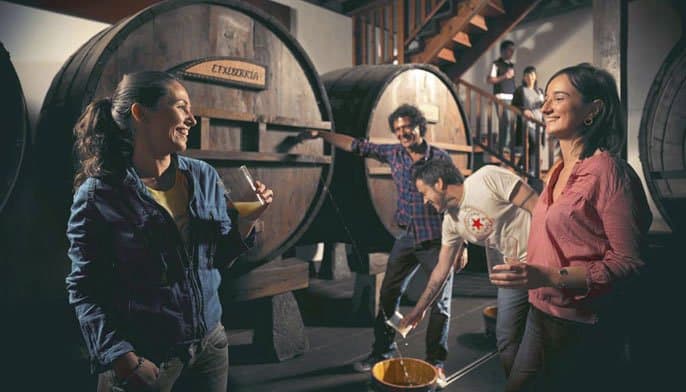
After the hike, it’s time to eat! Since we are in the Basque Country we will go to a traditional cider house to eat fresh fish, tender beef, and cheese from the local farms. These foods go perfectly with a tart, lightly carbonated hard apple cider, always poured directly from the barrel. While cider is a very tasty and even healthful drink, it’s easy to drink fast after a hike, so we encourage moderation.

FOOD AND WINE TOURS


roncesvalles

Cheese cake at La Viña in San Sebastián

Bar La Viña is on 31 de Agosto Street in San Sebastian’s old city. It is a very popular spot for pintxos, casual dinners and formal events for tourists and locals alike. Their formula for success consists of using all high quality ingredients. In the last few years the most popular menu item has become their cheesecake. It’s different than a traditional cheesecake, lighter in texture, and impossible to try without getting addicted. A stop at this lively bar located on one of the city’s most historic streets makes the perfect ending to a night out in the city.

I am posting this because many guests are amazed by this desert. They wanted to know how to make it so today I wanted to share the secret with you. Although you won’t have the same lively surroundings with a mix of strangers and friends, the big wooden bar covered with exquisite pintxos (unless you’re quite fortunate), and the thrill of spending a few days in this gorgeous coastal city, you will have this fabulous desert. I’ll leave the ambience up to you to create at home.

Cheese cake recipe

Use a cake pan about four inches deep. The only tricky part is the baking time. Depending on the oven and the pan, the time can vary slightly. The goal is a moist, spongy filling – test it with a cake tester or something similar as often as necessary. Eternal vigilance is the price of the perfect cheescake!

Ingredients:

  • 1kg cream cheese, such as Philadelphia
  • 5 egg
  • 350g sugar
  • 500ml heavy cream
  • 1 tablespoon flour

Preheat the oven to 230ºC/450ºF. Mix all the ingridients in a bowl and beat until smooth. Pour mixture in to the cake pan and bake for around 30 minutes or until a cake tester comes out clean. Best enjoyed at room temperature.

And that’s it! Enjoy!

Pintxo tour in San Sebastian


Aizepe is a typical gastronomic club in the Old Part of San Sebastian. It is located between the old port and Mount Urgull. The building was originally contructed around the XVIII century and was first used as a salt deposit for the Dutch merchants given its proximity to the port. During the napolenonic wars it was one of the few buildings to survive the raging fires that consumed the Old Part. These fires were set by the English-Portuguese troops who fought for months against the french invaders.

Today, it is a place for friends and family to get together to prepare the rich local products fruit of this land. The ritual is always the same, go to the local farmers market to buy fresh products, prepare them inside the gastronomic society with friends and finally sit down to enjoy the wonderful dishes prepared in a table that can seat as many or as few as desired.

One of our great chefs, although still in training, is Telmo Ezcurra. He is always willing to prepare something for the rest and makes sure that we have everything. In the Basque Country we believe that the first virtud of a good chef should be this, the desire to please the palate. There is no greater satisfaction for a chef that to see others enjoying that which he has prepared.

Another important chef in our small Aizepe family is Alain Alonso, blogger in Pintxo a Pintxo.   A great chef, also Basque and Donostiarra, a bit less conservative and more innovative in his dishes. He always manages to surprise us with something new hidden in traditional ingredients.

In addition to these noteworthy chefs that one can find in the kitchen at Aizepe, there is another group of people, of friends and family who also contribute an invaluable ingredient to the success of a dinner. It could be someone who brings the freshest ingredients, or who acts as somelier, setting the table, preparing coffee or even small bits of advice given in the kitchen. All together everything insures that things go perfectly.

This little article has made me realize how important it is to share life and its small joys with familie and friends. I can assure you that there are few places in the world like the gastronomic club to celebrate this sacred basque ritual of sharing a table with those we hold dear.

In winter, it is still possible to go river fishing in the Basque Country.  Close to San Sebastian there is one in particular that has great trout all year!  

The day was mostly cloudy which makes it perfect for river fishing.  We began the day fly fishing but with only a few nibbles and nothing to put into our basket. The brown trout on this river is quite large and so it is difficult to catch them with light equipment. 

In this photo, you see E.W.H, a professional rugby player on the Biarritz Olimpique team https://www.bo-pb.com/ , and his father.


river fishing san sebastian

Fishing in san sebastian


Around 2pm we decided to stop and enjoy a light lunch on one of the picnic tables along the riverbank.  We munched on local products such as cured ham, fresh bread, cheese and wine….perfect for restoring our strength to continue fishing.  I’ve always thought that a good picnic is paramount to a successful day of river fishing.  After lunch, we decided to change our technique and began spin fishing.  It wasn’t easy, but we finally caught three great specimens of brown trout.  
Around San Sebastian, there are many rivers with abundant trout.  In spring the season expands to include all rivers and it is the best time for this sport.  I would love to take you on a fishing excursion with San Sebastian Trips!